

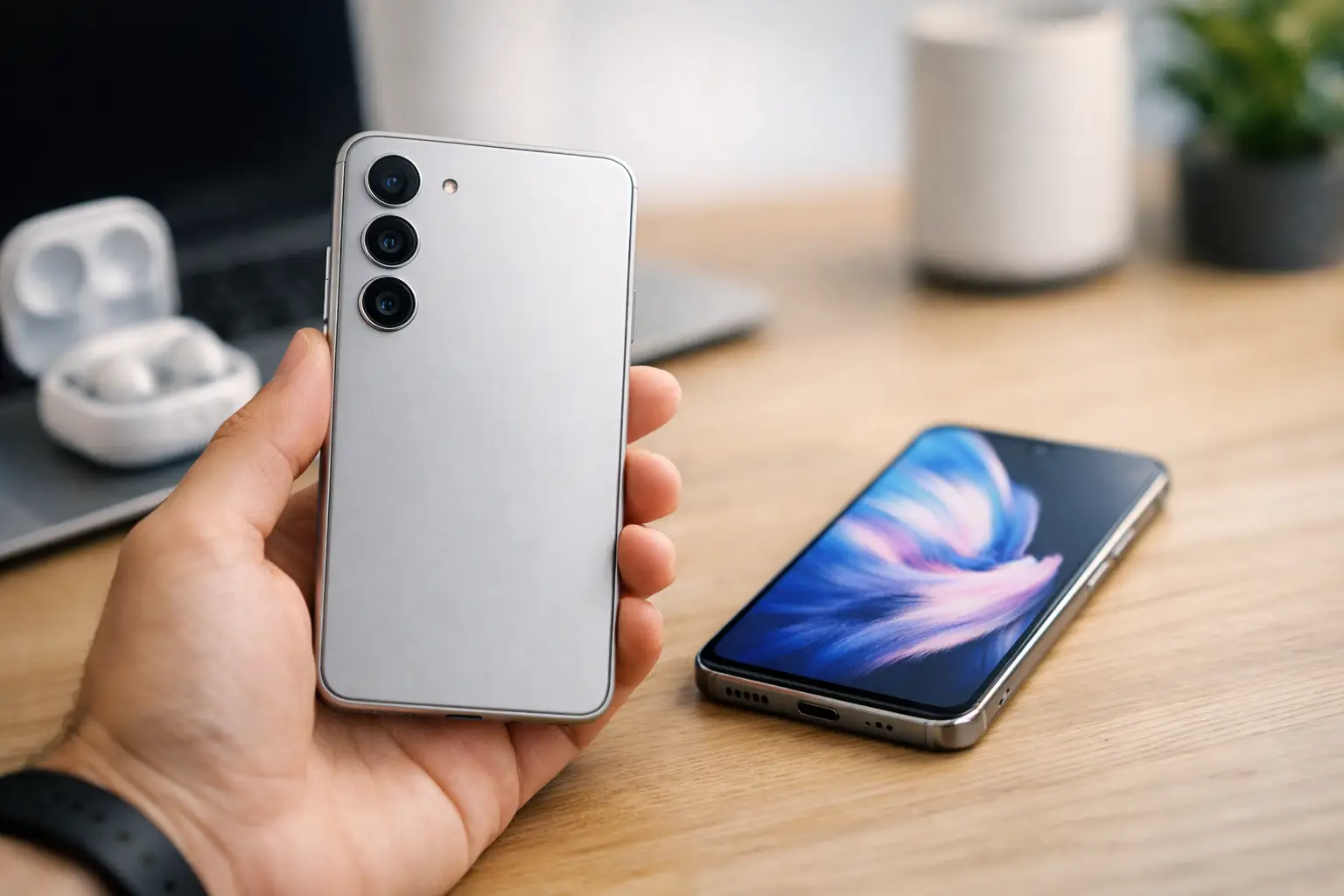
The Samsung Galaxy S25 arrives at a point when compact flagship phones are becoming harder to find. It keeps the familiar 6.2-inch screen and pocket-friendly size of its predecessor, but adds a much faster processor, refined Galaxy AI features, and a longer-term software promise that matters more than one headline-grabbing spec. For buyers who want a premium Android phone without moving to a larger Plus or Ultra model, this is one of Samsung’s most balanced options.
The catch is that several hardware elements, especially the camera sensors and battery capacity, look very similar to the Galaxy S24. That makes this a strong new purchase for people coming from an older device, while Galaxy S24 owners should look closely at what they would gain before trading in.
Samsung Galaxy S25 review: design and display
Samsung has not tried to reinvent the standard Galaxy S design. The Galaxy S25 is slim, light, and easy to operate with one hand. Its flat aluminum frame, matte glass back, and separate camera rings give it a clean, recognizable look. The phone carries an IP68 rating for dust and water resistance, offering useful protection against rain, spills, and brief submersion.
Its 6.2-inch Dynamic AMOLED 2X display remains a major strength. It is sharp, colorful, and bright enough for navigation, messaging, and video outdoors. The adaptive 120Hz refresh rate makes scrolling feel responsive, while the smaller size is a genuine advantage for readers who find 6.7-inch phones cumbersome.
The screen does not offer the anti-reflective coating found on the Galaxy S25 Ultra, and that difference can be noticeable in intense direct light. Still, the standard S25 display is excellent for its class. Unless you specifically need a larger canvas for editing, gaming, or split-screen work, it does not feel like a compromise.
A compact flagship with practical trade-offs
The smaller dimensions affect battery space and camera hardware. Samsung has kept a 4,000mAh battery, along with 25W wired charging and 15W wireless charging. Those specifications are not class-leading, particularly when some competitors offer much faster wired charging.
However, the S25’s size is the point. It is designed for people who prioritize comfort, low weight, and a screen that does not dominate a pocket. If long gaming sessions, frequent hotspot use, or two-day battery life are priorities, the Galaxy S25+ is the more suitable option.
Performance: a meaningful upgrade
The most important hardware improvement is the Snapdragon 8 Elite for Galaxy processor. Samsung’s customized chip gives the Galaxy S25 a substantial increase in CPU and graphics performance compared with recent Galaxy models. Everyday tasks feel immediate, but the bigger benefit is headroom: demanding games, 4K video editing, AI features, and multitasking are better positioned to remain fast over several years.
Samsung also equips the S25 with 12GB of RAM, a welcome change from the lower memory configuration used on earlier base models. Apps stay available in memory longer, and switching among a browser, camera, maps, and messaging apps is consistently smooth.
For most people, performance will not be the reason to upgrade from a Galaxy S24. That phone is already quick. But for someone using a Galaxy S21, S22, or an older midrange phone, the difference is immediately noticeable. The S25 feels built for the next generation of Android features rather than merely capable of running them.
Storage starts at 128GB in some configurations, with 256GB and 512GB options available. Because there is no microSD card slot, buyers who capture lots of video or download large games should consider 256GB as the practical starting point.
Cameras: reliable, but not a major hardware leap
The Galaxy S25 uses a familiar three-camera setup: a 50MP main camera, 12MP ultrawide camera, and 10MP telephoto camera with 3x optical zoom. On paper, this is largely unchanged from the Galaxy S24. Samsung instead focuses on processing improvements powered by the new chipset.
In good light, the main camera produces detailed photos with Samsung’s typically vibrant color processing. The 3x telephoto lens remains useful for portraits, travel photos, and capturing subjects that are just out of reach. Having a dedicated optical zoom camera is still an advantage over phones that rely only on digital cropping.
Low-light photos are generally bright and usable, although Samsung’s processing can occasionally smooth fine detail or brighten scenes beyond their natural appearance. The ultrawide camera is capable for landscapes and group shots, but it is the least impressive lens in the set when lighting drops.
Video quality is strong, with stable footage and useful shooting options for creators. Samsung has also expanded its editing tools, including audio cleanup features that can help reduce distracting background noise in selected clips. These tools are convenient, but they are not magic. A recording made close to traffic, wind, or a loud crowd will still benefit from good microphone placement.
The camera system is dependable rather than groundbreaking. Buyers who want the most flexible zoom range or the best possible low-light imaging should compare the S25 Ultra and competing premium camera phones. For everyday family photos, social posts, travel, and video calls, the standard S25 is more than capable.
Galaxy AI is more useful when it saves time
Samsung’s software approach is becoming a key part of the S25 experience. The phone launches with Android 15 and One UI 7, bringing a cleaner visual style, improved notifications, and deeper AI integration across Samsung and Google services.
Features such as Circle to Search, writing assistance, call transcription, translation, and photo editing can be genuinely helpful in the right situations. The best examples are simple: quickly identifying an item on screen, cleaning up a photo before sharing it, or summarizing a long note after a meeting.
The new Now Brief feature attempts to gather relevant information, such as weather, calendar items, and health details, into a personalized daily view. Its usefulness depends on how much of Samsung’s ecosystem and supported apps you use. Readers who prefer a minimalist setup may see it as optional rather than essential.
There is also a privacy consideration. Some AI tasks run on the device, while others may use cloud processing depending on the feature and settings. It is worth reviewing the phone’s Galaxy AI privacy controls, especially before processing sensitive notes, recordings, or images. Helpful software should not mean ignoring where personal data is handled.
Battery life and charging
Despite retaining the 4,000mAh battery, the Galaxy S25 can generally make it through a full day of moderate use. Messaging, social media, web browsing, music streaming, photography, and occasional navigation are well within its comfort zone. The efficient Snapdragon chip helps, particularly during lighter tasks.
Heavy users may need a top-up before bedtime. High screen brightness, extended camera use, mobile gaming, and weak cellular signal all have a predictable effect on a compact phone’s endurance. This is not poor battery life, but it is not exceptional either.
Charging is the area where Samsung feels conservative. The 25W wired limit is adequate but slower than many Android rivals, and the charging adapter is sold separately. The phone supports Qi2-compatible accessories through Samsung’s magnetic case options, which can make desk and bedside charging more convenient, but built-in magnets would have been a more complete solution.
Software support adds real value
Samsung promises seven generations of Android OS upgrades and seven years of security updates for the Galaxy S25. That commitment changes the ownership calculation. A phone bought in 2025 can remain current and protected far longer than the typical two- or three-year upgrade cycle.
Long support does not guarantee that every future feature will run identically on older hardware, but the S25 has enough performance and memory to age well. For users who want to spend less over time and avoid unnecessary device replacement, that is one of the phone’s strongest selling points.
Is the Galaxy S25 worth buying?
At its $799.99 starting price, the Galaxy S25 is a polished compact flagship rather than a dramatic redesign. Its strongest qualities are speed, display quality, manageable size, dependable cameras, and unusually long software support. It is particularly appealing for Android users upgrading from a Galaxy S22 or older device, as well as anyone who wants flagship performance without a massive screen.
Galaxy S24 owners have less reason to rush. The new processor, extra RAM, and newer AI tools are real improvements, but the design, display, battery, and camera hardware are close enough that waiting for a better trade-in offer or another generation may be sensible.
For a new buyer, the Galaxy S25 is easy to recommend if compact comfort matters as much as specifications. Choose the storage tier you can live with for years, take a few minutes to configure the AI privacy settings, and you will have a fast, capable phone that should remain useful well beyond the usual upgrade cycle.
